Agentic Commerce: UCP vs ACP and What Shopify Stores Can Do Now

UCP is the shared standard Google built with Shopify and others, covering everything from product search to order management. ACP is the standard OpenAI and Stripe built to connect ChatGPT with merchants. How the two differ, how an order goes through inside an AI, and what a Shopify store can do today, checked against official sources as of October 2026.
UCP and ACP are both shared standards for connecting AI agents to online stores. UCP (Universal Commerce Protocol) was built by Google with Shopify and others, and covers everything from product search to order management. ACP (Agentic Commerce Protocol) was built by OpenAI and Stripe, and covers how product data and payment credentials pass between ChatGPT and a store.
Agentic commerce is the kind of shopping these standards make possible: an AI finds products for a shopper and carries the purchase through. In September 2026, Shopify’s CEO announced on X that shoppers would be able to buy from Shopify stores with Shop Pay inside Muse, Meta’s AI agent.
This article is for people running a store on Shopify or another platform. It covers:
- How UCP and ACP differ (and where AP2 and MCP fit)
- How an order goes through inside an AI
- Where ChatGPT, Google, Meta and Copilot stand, and which stores qualify
- What to set up now
- Common misconceptions
Everything here is checked against official pages from Google, OpenAI, Shopify, Stripe and Microsoft as of October 2026. The rules change month to month, and we’ll update this page when they do.
What is agentic commerce?
Agentic commerce is shopping where an AI agent finds, compares and buys products on the shopper’s behalf. Of the usual steps (search, browse several sites, add to cart, check out), the AI takes over the ones in the middle.
For a store, what changes is where shoppers first meet your products. Until now, you could count on search results and ads to bring people to your site. With agentic commerce, your products get recommended inside an AI’s answer, and sometimes the purchase finishes without the shopper ever leaving the AI.
Shopify’s answer to this is agentic storefronts. Its help center describes it like this:
Shopify’s agentic storefronts lets customers discover and purchase your products in AI channels, such as ChatGPT, Google AI Mode and Gemini, Microsoft Copilot, and Meta.
It’s active by default for eligible stores, and you choose which AI channels to sell on under Sales channels > Agentic in your Shopify admin. Orders go into your admin like any other order, with the channel or referrer shown.
UCP vs ACP
UCP is Google’s broad standard covering search through order management; ACP is the standard OpenAI and Stripe built for buying in ChatGPT. Both keep the store as the seller of record. The main differences:
| UCP (Universal Commerce Protocol) | ACP (Agentic Commerce Protocol) | |
|---|---|---|
| Built by | Google, co-developed with Shopify, Etsy, Wayfair, Target and Walmart. Endorsed by more than 20 companies including Adyen, American Express, Mastercard, Stripe and Visa | OpenAI and Stripe |
| Released | January 11, 2026 | September 29, 2025 |
| What it defines | Product search and details, cart, checkout, account linking (OAuth 2.0), order status updates, payment handoff | Product data ChatGPT receives, checkout flow, payment credential handoff (Delegated Payment) |
| Where it’s used | Google AI Mode and Gemini; Shopify’s agent tooling. Microsoft says Microsoft Merchant Center will support UCP | ChatGPT. Stripe’s Shared Payment Token was the first payment implementation |
| Payments | Google Pay (payment methods saved in Google Wallet) and others, combined as “payment handlers” | Stripe tokens first; other payment providers can support the spec |
| License | Apache 2.0 (open source) | Apache 2.0 (open source) |
| Availability | Merchant onboarding in Merchant Center is rolling out in the US, with Canada and Australia next year. Google said on May 20, 2026 that UCP-powered buying will reach Canada and Australia in the coming months, then the UK | ChatGPT shopping is live for US users |
(Sources: Google Developers Blog, ucp.dev, agenticcommerce.dev, OpenAI, Google Merchant Center Help, ChatGPT for merchants. Checked October 2026.)
It’s easier to think of them as different standards for different entry points than as rivals. Stripe’s docs list “UCP or ACP” as the protocols for selling through agents, and Stripe also sits on UCP’s Tech Council.
Where AP2 and MCP fit
AP2 and MCP often come up in the same news stories as UCP and ACP. Here’s what each one covers:
| Standard | Full name | From | Released | What it covers |
|---|---|---|---|---|
| AP2 | Agent Payments Protocol | Google (with more than 60 organizations) | September 16, 2025 | Payments made by agents. Records the user’s instructions (Intent Mandate) and approved cart (Cart Mandate) as signed records |
| MCP | Model Context Protocol | Anthropic | November 2024 | A general way to connect AI to external tools and data. Not specific to shopping |
UCP is designed to work with AP2, A2A (a standard for agent-to-agent communication) and MCP. Shopify’s agent tooling implements UCP over MCP.
How an order goes through inside an AI
Buying inside an AI breaks into four handoffs: product data, checkout, payment and order updates. UCP and ACP define the format of those handoffs. Under both, the store stays the merchant of record; the AI company doesn’t buy and resell your products.
- Product data: your product information (title, description, price, inventory, images, shipping terms) goes to the AI. Under ACP, the merchant sends a CSV or JSON product feed on a schedule. Shopify stores’ products reach the AI channels through Shopify Catalog.
- Checkout: when the shopper decides to buy, the AI asks your store’s API to create a checkout. Your side checks inventory, calculates shipping and tax, screens for fraud, and decides whether to accept the order.
- Payment handoff: the AI doesn’t pass the shopper’s card number to you; it passes a token. Under ACP, Stripe’s Shared Payment Token was the first implementation, and each token is limited to a maximum amount and an expiry. Under UCP, a “payment handler” for each payment method defines how it’s tokenized and handed over. It can also be combined with AP2’s signed records.
- Order updates: your store tells the AI about order status: shipped, delivered, returned, refunded. UCP defines webhooks for order status changes.
How much work this is depends on whether you build it or your platform does. Shopify handles it behind agentic storefronts, so Shopify stores don’t need to implement either standard. A custom-built store that wants to sell in Google AI Mode has to implement UCP following Google’s developer guide first.
ChatGPT, Google, Meta and Copilot: where things stand
“You can buy it in AI” means different things depending on the channel, because the purchase finishes in different places. Shopify’s help center treats ChatGPT as a discovery channel that sends shoppers to your store. Google, Microsoft and Meta support direct checkout, where the purchase finishes in Shopify-powered checkout inside the AI.
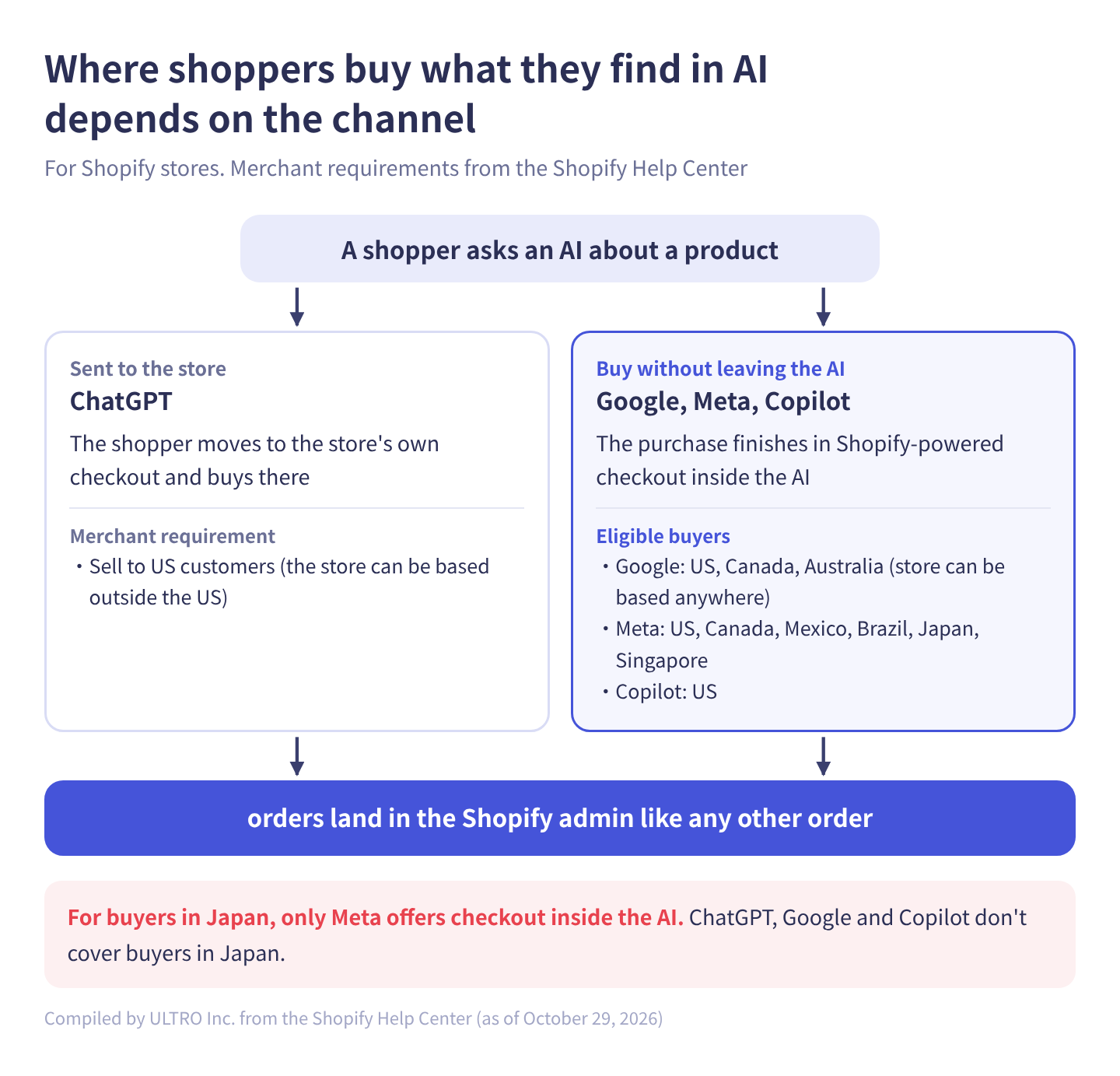
In table form:
| Channel | Where the purchase finishes | Merchant requirements |
|---|---|---|
| ChatGPT | Your online store checkout (in ChatGPT’s in-app browser or a new tab) | Sell to US customers. The store can be based outside the US (Shopify Help Center) |
| Google AI Mode and Gemini | Inside the AI (direct checkout, on by default) | Store based in the US and selling to US customers, with a valid Merchant Center account (Shopify Help Center). Direct checkout is shown only to US buyers |
| Meta (Muse and other surfaces) | Inside the AI (direct checkout, on by default) | Sell to customers in the US, Canada, Mexico, Brazil, Japan or Singapore (Shopify Help Center, checked October 29, 2026). Shoppable ads require the Facebook & Instagram sales channel with product syncing on (Shopify Help Center) |
| Microsoft Copilot | Inside the AI (Copilot Checkout) | English-language merchant selling to US buyers in USD. Shopify merchants are enrolled automatically (Microsoft Advertising) |
Across all channels, your products need to be eligible for Shopify Catalog and you need to accept the Shopify Agentic Storefronts Supplemental Terms of Service. The ChatGPT page also requires a terms of service, privacy policy and return and refund policy set up in your admin.
For Copilot Checkout, Microsoft lists PayPal, Shopify and Stripe as its payment partners. Shopify merchants are enrolled automatically, with controls in the Shopify admin.
ChatGPT moved away from standalone Instant Checkout
Buying in ChatGPT started on September 29, 2025 as Instant Checkout, which let shoppers pay without leaving ChatGPT. ACP was released as the standard behind it. Many explainers still assume that’s how it works.
As of October 2026, OpenAI’s merchant page says:
We’re moving away from a standalone Instant Checkout experience in ChatGPT.
Purchases are instead completed on merchants’ own sites or apps. OpenAI’s developer docs still describe Instant Checkout for approved partners. The same merchant page says ChatGPT shopping is live for US users and that merchants selling through Shopify or Etsy already have their catalogs integrated.
For Shopify stores, shoppers who find your products in ChatGPT move to your own checkout. Shopify’s help center says there’s no setting to turn ChatGPT direct checkout on or off. From the store’s side, ChatGPT isn’t where the purchase happens; it’s where shoppers find your products and get sent to your store.
Muse is now in Japan too, and supports Shop Pay
Muse is a personal AI agent Meta launched on September 8, 2026. It runs as its own app and inside WhatsApp, and launched in the US first. Meta announced it started offering Muse in Japan on October 23, 2026. Shopify’s help center says Shop Pay can display as a wallet or checkout option in Muse, and you don’t need to turn on Shop Pay separately for it.
On the merchant side, you need to sell to customers in the US, Canada, Mexico, Brazil, Japan or Singapore. When we checked Shopify’s help center on October 29, 2026, Japan was on the list (earlier it was the US, Canada and Mexico only).
Which stores can sell through AI channels today
As of October 29, 2026, whether you can sell depends on where your buyers are. Here’s how the requirements above play out:
| Your store | ChatGPT | Google AI Mode and Gemini | Meta (Muse) | Copilot |
|---|---|---|---|---|
| Based in the US, selling to US buyers | Eligible | Eligible | Eligible | Eligible (in English, USD) |
| Based outside the US, selling to US buyers | Eligible | Eligible (store can be based anywhere) | Eligible | Eligible if you sell in English and USD |
| Selling only to Canada | Not eligible | Eligible | Eligible | Not eligible |
| Selling only to Japan | Not eligible | Not eligible | Eligible | Not eligible |
The row to watch is the second one. For ChatGPT and Meta, the requirement is where your buyers are, not where your store is. Agentic storefronts are on by default for eligible stores, so if you sell internationally into the US, AI channels may already be recommending and selling your products without you having changed anything.
Google said on May 20, 2026 that UCP-powered buying will expand to Canada and Australia in the coming months, then to the UK, and Merchant Center onboarding for Canada and Australia is planned for next year. No other countries have been announced. We don’t speculate on dates here; we’ll update the tables when announcements come.
What Shopify stores can do now
If you sell to US buyers, these channels are likely already live for you, so the first job is to check what’s on. If you don’t, there’s nothing you have to change today, and the work is getting ready so you can sell as soon as you qualify. None of this is only for AI channels: it also helps Google Shopping listings and AI search.
1. Check your agentic settings in Shopify
In your Shopify admin, go to Sales channels > Agentic and see which AI channels are active. If you sell to buyers in the covered countries (Japan included, for Meta), some may already be on. Also check the channel shown on recent orders to see whether any AI channel orders have come in.
2. Fill in your three policies
Shopify’s help center lists a terms of service, privacy policy and return and refund policy as requirements for selling on ChatGPT. Go to Settings > Policies and check that none are blank. Spell out the return window, method and who pays return shipping: AI assistants draw on this when shoppers ask questions.
3. Know which products direct checkout can’t sell
Shopify’s help center says subscriptions, product bundles, customizable products and B2B-only products aren’t supported in Google’s or Meta’s direct checkout. If those are your core products, assume AI shoppers will be sent to your store to buy rather than buying inside the AI. Shopify’s ChatGPT page also says to put any legally required disclosures in the first 6,000 characters of each product description.
4. Clean up product data in Merchant Center and Shopify Catalog
Product information reaches AI channels through Shopify Catalog or Google Merchant Center. Selling in Google AI Mode and Gemini requires a valid Merchant Center account, and product discovery there is powered by Merchant Center. Keeping titles, descriptions, product categories and inventory accurate also improves your Merchant Center feed quality.
5. Decide how you’ll track AI orders
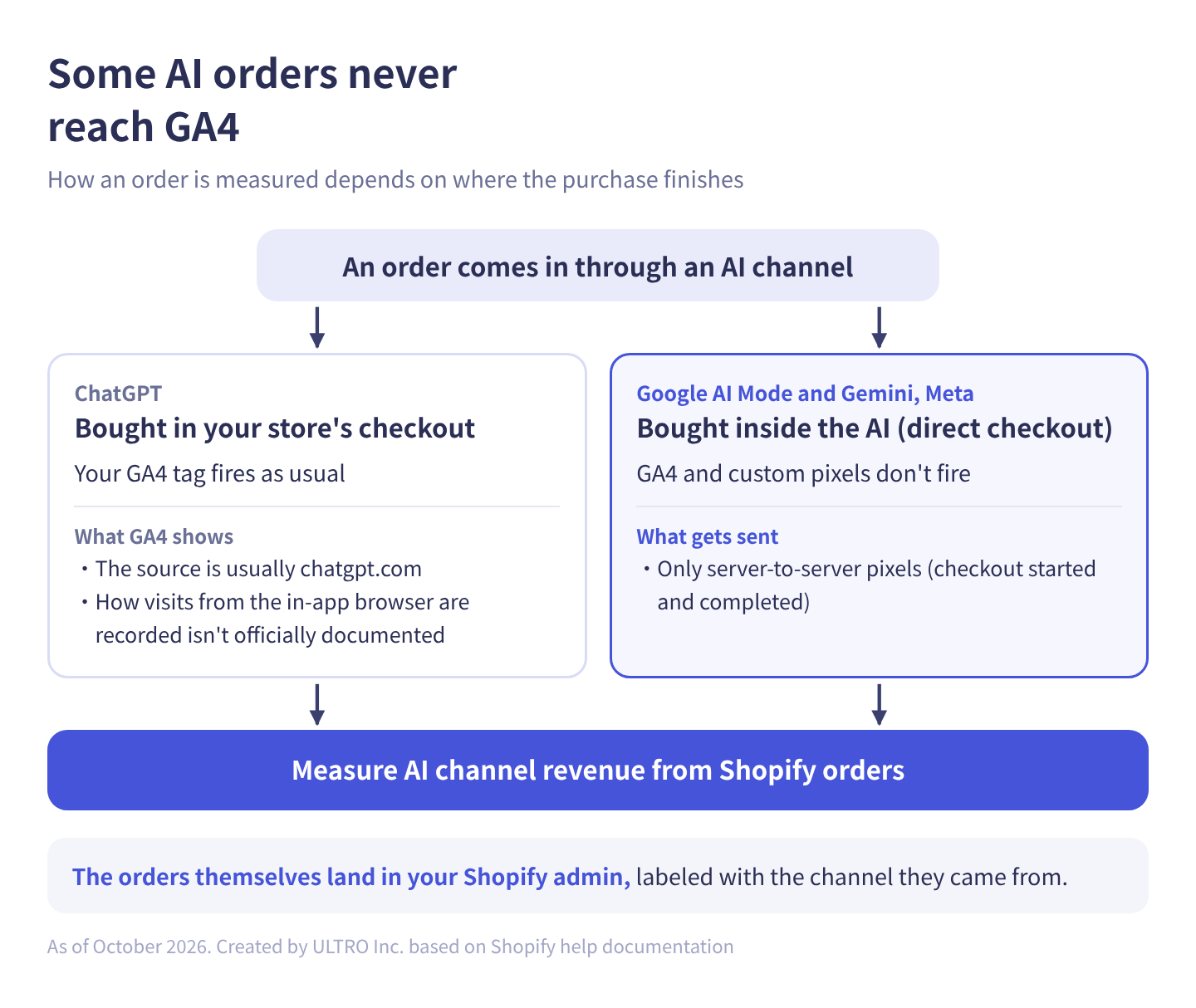
For direct checkout in Google AI Mode and Gemini, Shopify’s help center says:
Google Analytics and custom pixels won’t fire in Google AI Mode and Gemini’s direct checkout.
Only server-to-server pixels (checkout started and completed) fire. The Meta page says the same, and adds that third-party analytics pixels don’t fire on direct checkouts completed on a Meta surface. Orders placed inside the AI don’t reach GA4 as purchases.
The orders themselves land in your Shopify admin, labeled with the channel. The practical move is to agree internally, before the volume grows, that AI channel revenue gets reported from Shopify orders, not GA4. If you judge ad ROAS from GA4 purchases, make sure everyone knows that orders placed inside an AI won’t be credited to any ad.
ChatGPT sends shoppers to your own checkout, so your GA4 tag fires as usual. For how to find ChatGPT traffic in GA4 and reconcile AI orders with Shopify, see GA4 AI Assistant Channel.
If you want orders placed inside an AI in GA4 too, they have to be sent from a server. We built a Shopify app, GapFill, that recovers missing GA4 purchase events server-side. It’s our own product, so read with that in mind. It works alongside your existing tags, the missing purchases report is free, and agentic checkouts can be sent with a source and medium based on the sales channel.
Our Shopify appGapFill: Recover missing GA4 purchase events server-sideWorks alongside your existing tags. Free missing purchases report.See GapFill →6. Not on Shopify? Know where to apply
If you run a custom-built store or another platform, each AI company has its own route. Google’s is selective: you implement UCP following the developer guide, submit an interest form, and if Google selects you, you get a sandbox in Merchant Center to test. As of October 2026, it’s rolling out gradually in the US, with Canada and Australia to follow next year. For ChatGPT, you apply to share product data through OpenAI’s merchant page (chatgpt.com/merchants), and applicants go on a waitlist.
In January 2026, Shopify also announced an Agentic plan that, per its news post, opens Shopify Catalog to brands whose online store isn’t on Shopify. Per Shopify’s help center, you keep your existing online store, and direct checkout is off by default on that plan.
Common misconceptions
Agentic commerce comes with a lot of new terms, and standards often get mixed up with individual companies’ features. Six we see often:
You have to choose between UCP and ACP
Not on Shopify: Shopify handles both behind agentic storefronts. If you wire up payments yourself, Stripe supports “UCP or ACP.” Only when you build it yourself do you choose, working back from the entry point you want (Google or ChatGPT).
UCP is only for Google’s AI
Google leads UCP, but it was co-developed with Shopify, and Shopify’s agent tooling implements it. Microsoft Advertising also says Microsoft Merchant Center will support UCP (as a future plan, adding richer signals on top of product feeds). Copilot Checkout’s payment partners are PayPal, Shopify and Stripe.
Shoppers pay inside ChatGPT
That was true at launch in September 2025. As of October 2026, OpenAI says it’s moving away from a standalone Instant Checkout experience. For Shopify stores selling on ChatGPT, the purchase finishes in your own checkout.
Any Shopify store can sell through AI worldwide
As of October 29, 2026, Meta is the only channel that covers buyers in Japan. Google covers the US, Canada and Australia, and ChatGPT and Copilot the US.
If people buy inside AI, you won’t need your own site
ChatGPT sends shoppers to your checkout, and even on channels where shoppers can buy inside the AI, we expect many to visit your site to double-check before buying. That only helps if prices, inventory and return terms match between your site and the data you give the AI.
Supporting MCP lets AI shop on your store
MCP is a general way to connect AI to external tools and data. On its own, it doesn’t define payments or order handling. UCP and ACP define checkout and payment handoff, and MCP is one transport they can use.
Fact vs speculation
Coverage of agentic commerce often mixes facts with predictions. Here’s how confident we are in each claim on this page:
| Claim | Confidence | Basis |
|---|---|---|
| Google announced UCP, co-developed with Shopify and others, on January 11, 2026 | Fact | Google Developers Blog, Shopify |
| OpenAI and Stripe released ACP on September 29, 2025 | Fact | OpenAI, agenticcommerce.dev |
| Stripe supports both UCP and ACP for selling through agents | Fact | Stripe docs |
| Shopify stores connect to ChatGPT, Google, Copilot and Meta AI channels by default if eligible | Fact | Shopify Help Center |
| As of October 29, 2026, Meta covers buyers in Japan; ChatGPT, Google and Copilot don’t | Fact | Shopify Help Center, OpenAI, Microsoft Advertising |
| ChatGPT has moved away from standalone Instant Checkout; purchases finish in the store’s checkout | Fact | OpenAI merchant page, Shopify Help Center |
| GA4 and custom pixels don’t fire in direct checkout | Fact | Shopify Help Center (Google, Meta) |
| Stores based outside the US that sell to US buyers can be sold through ChatGPT, Meta and Copilot | Partly fact | Shopify says so explicitly for ChatGPT. For Meta and Copilot, the published requirements cover only buyer country (and language and currency), not store location |
| AI buying will soon expand beyond the announced countries | Speculation | Only Canada, Australia and the UK have been announced (Google) |
| Richer product descriptions make AI recommend your products more | Not guaranteed | How recommendations work isn’t published |
Sources
- Under the Hood: Universal Commerce Protocol (UCP) (Google Developers Blog, January 11, 2026)
- How we’re helping retailers thrive with new Universal Commerce Protocol features and AI tools on Google (Google, May 20, 2026)
- How to onboard to the UCP integration hub in Merchant Center (Google Merchant Center Help)
- About the Universal Commerce Protocol (UCP) and UCP-powered checkout feature on Google (Google Merchant Center Help)
- Announcing Agent Payments Protocol (AP2) (Google Cloud Blog, September 16, 2025)
- Universal Commerce Protocol (ucp.dev)
- Agentic Commerce Protocol (agenticcommerce.dev)
- Buy it in ChatGPT (OpenAI, September 29, 2025)
- ChatGPT for merchants (OpenAI)
- Agentic Commerce: Key concepts (OpenAI Developers)
- Agentic commerce (Stripe Docs)
- Universal Commerce Protocol (Stripe Docs)
- Agentic commerce (Microsoft Advertising)
- AI commerce at scale (Shopify, January 11, 2026)
- Agents (Shopify.dev)
- Shopify agentic storefronts (Shopify Help Center)
- Selling on ChatGPT (Shopify Help Center)
- Selling on Google AI Mode and Gemini (Shopify Help Center)
- Selling on Meta (Shopify Help Center)
The Muse partnership was announced in a post on X by Tobi Lütke (Shopify CEO). Muse’s launch date and availability come from press coverage including PBS NewsHour (September 2026). For how Shopify’s ChatGPT integration changed in March 2026, we referred to Digital Commerce 360 (March 17, 2026).
FAQ
What is agentic commerce?
It's shopping where an AI agent finds, compares and buys products on a shopper's behalf. ChatGPT, Google AI Mode and Gemini, Microsoft Copilot and Meta's Muse are the main entry points. The merchant remains the seller (merchant of record); the AI company doesn't buy and resell the product.
What's the difference between UCP and ACP?
UCP (Universal Commerce Protocol) was announced by Google on January 11, 2026, co-developed with Shopify, Etsy, Wayfair, Target and Walmart. It covers product search, carts, checkout, account linking and order management, and powers buying in Google AI Mode and Gemini. ACP (Agentic Commerce Protocol) was released by OpenAI and Stripe on September 29, 2025, and defines how ChatGPT receives product data and passes payment credentials securely to the merchant. Both are open source under Apache 2.0, and Stripe supports both.
How do AP2 and MCP relate to UCP and ACP?
AP2 (Agent Payments Protocol), announced by Google on September 16, 2025, is a standard for payments made by agents. It records the user's instructions and approved cart as signed mandates. MCP (Model Context Protocol) is a general way to connect AI to external tools and data; it isn't specific to shopping. UCP is designed to work with AP2, A2A and MCP.
Can my Shopify store sell on ChatGPT?
Shopify's help center says your store must sell to customers in the United States, and it can be based outside the US. You also need a terms of service, privacy policy and return and refund policy in Settings > Policies. Shoppers who find your products in ChatGPT complete the purchase on your online store checkout.
Can shoppers pay inside ChatGPT?
Generally not, as of October 2026. OpenAI's merchant page says it's moving away from a standalone Instant Checkout experience in ChatGPT, with purchases completed on merchants' own sites or apps. For Shopify stores, ChatGPT shoppers check out on your online store, in ChatGPT's in-app browser or in a new tab.
How can a store that isn't on Shopify sell through UCP or ACP?
Google's program is selective: you implement UCP following the developer guide, submit an interest form, and if selected you get a sandbox in Merchant Center. As of October 2026 it's rolling out gradually in the US, with Canada and Australia to follow next year. For ChatGPT, you apply to share product data through OpenAI's merchant page, and applicants are placed on a waitlist.
Does GA4 track orders placed inside an AI assistant?
Not for direct checkout. Shopify's help center says Google Analytics and custom pixels don't fire in Google AI Mode and Gemini's direct checkout or in Meta's direct checkout; only server-to-server pixels (checkout started and completed) fire. The orders appear in your Shopify admin with the channel name, so use Shopify order data as the baseline for AI revenue.
- Agentic commerce is shopping where an AI agent finds products and completes the purchase for a shopper. UCP and ACP are the shared standards that connect merchants and AI.
- UCP is Google-led (co-developed with Shopify and others) and covers search, cart, checkout and order management. ACP is from OpenAI and Stripe and covers product data and payment handoff for ChatGPT. Stripe supports both.
- Under both, the merchant stays the merchant of record. Card details are passed as tokens, not raw numbers (ACP's Shared Payment Token is capped by amount and time).
- ChatGPT has moved away from standalone Instant Checkout and sends shoppers to your checkout. Google, Meta and Copilot support direct checkout inside the AI.
- As of October 29, 2026: ChatGPT and Copilot need US buyers, Google covers the US, Canada and Australia (store can be based anywhere), and Meta covers the US, Canada, Mexico, Brazil, Japan and Singapore
- What to do now: check Sales channels > Agentic, fill in your three policies, know which products direct checkout can't sell, clean up product data, and decide how you'll track AI orders.
Written byRyushi Nagata
CEO, ULTRO Inc. (Tokyo)Shopify Partner. Ryushi handles Shopify store builds, maintenance, advertising and CRM end to end, and has managed more than ¥4 billion in ad spend over his career. He holds Google Ads certifications (Search, Display, Video, Shopping, Apps, Performance Max, Measurement) and the Google Analytics certification.
How many purchases is GA4 missing in your store?
GapFill matches your Shopify orders against GA4 purchases, shows what GA4 missed, and recovers those purchase events server-side. It works alongside your existing tags, and the missing purchases report is free.